A uniquely French 1980's & 90's experience... the Minitel
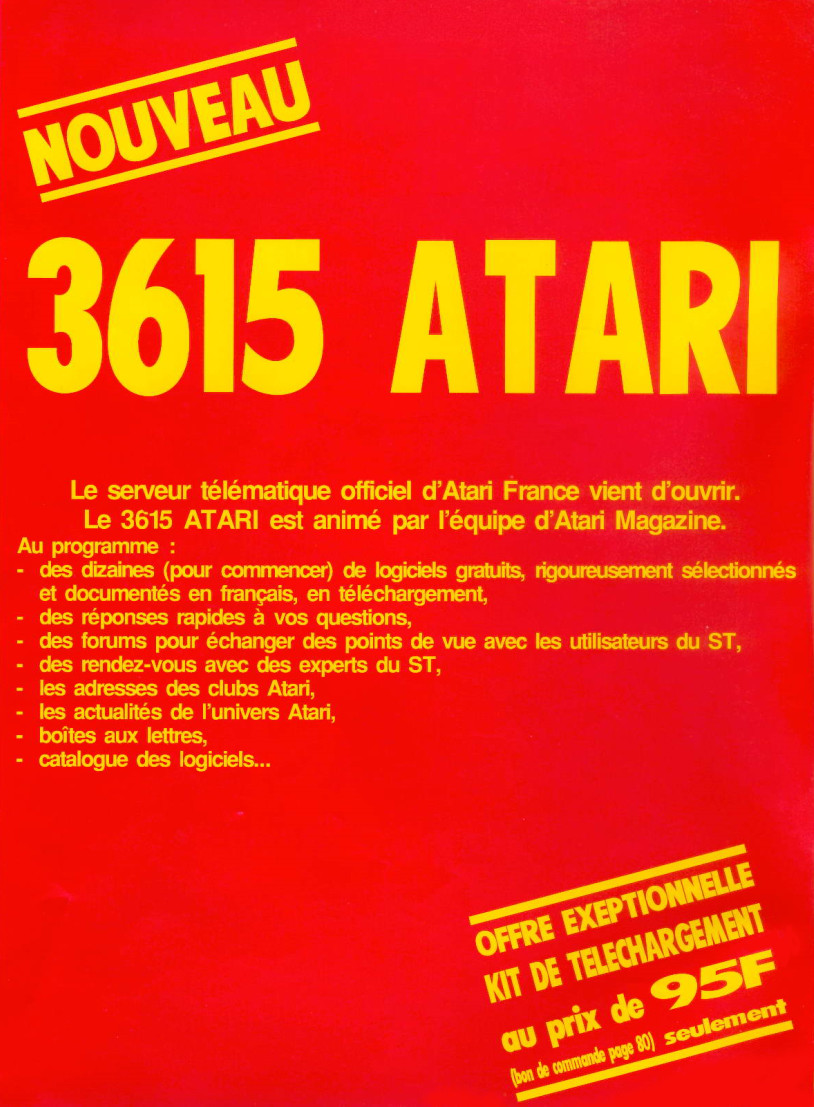
For a French audience, the meaning of the title "3615 ATARI" in a 1989 advert is immediately clear.
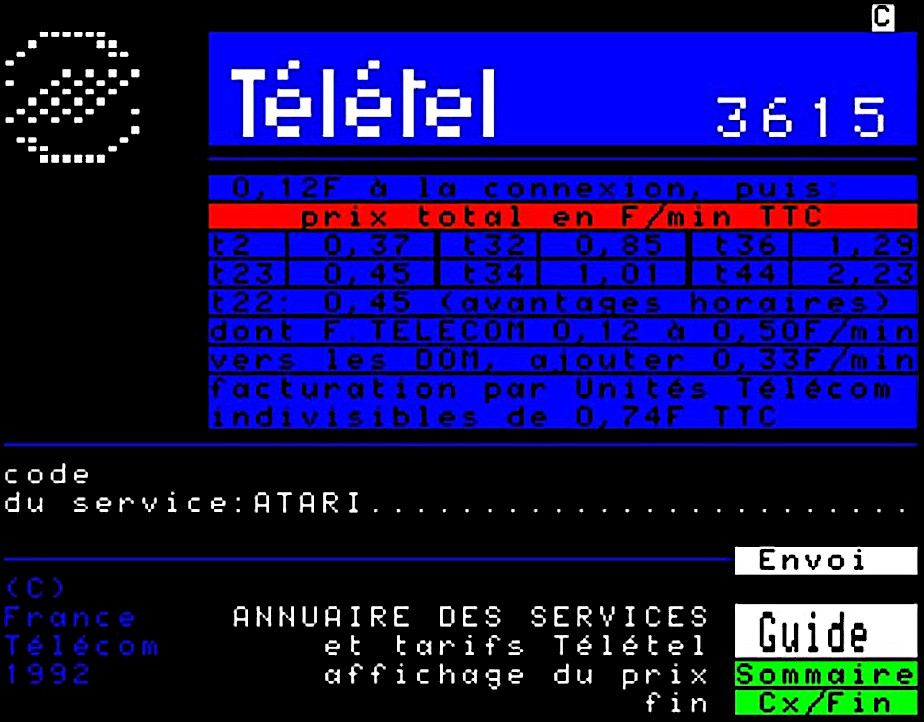
For an international audience, however, "3615 ATARI" requires some explanation. That four-digit telephone number and service name were the equivalent, in today's terms, of a website's URL, with one small difference: 3615 was a chargeable service.
In details:
"3615" was the telephone number you had to dial on the Minitel to use a chargeable (standard-rate) service, with charges calculated by the minute.
"ATARI" was the name of the service you had to type in to connect to it.
Minitel is regarded as one of the world's most successful pre-web online service initiatives. It helped millions of French people become familiar with using a terminal and digital networks. And it enabled thousands of French developers and entrepreneurs to create services, which were subsequently able to migrate to the internet.
What sort of services were available on 3615 ATARI?
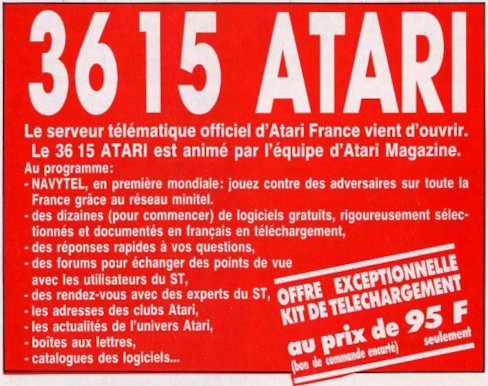
The advert that appeared regularly in the first issues of "Atari Magazine" states this, specifically
Atari France's official telematics server has just gone live.
The 3615 ATARI service is run by the team at Atari Magazine.
Overview of the services available:
- NAVYTEL, a world first: play against opponents across France via the Minitel network,
- Dozens (to start with) of free software programs available to download, carefully selected and documented in French,
- Quick answers to your questions,
- Forums to exchange views with ST users,
- Meetings with ST experts,
- Addresses of Atari clubs,
- News from the Atari world,
- Email boxes,
- Software catalogues.
But if all this took place in the early 1990s, with a clear focus on the Atari ST and later the STE, why mention it on a website dedicated to Atari 8-bit computers?
Quite simply because Atari's 8-bit computers have not been completely forgotten. The 3615 ATARI Minitel site was divided into two main sections, L'ordinateur à la maison (The computer at home) and L'ordinateur au bureau (The computer at the office).
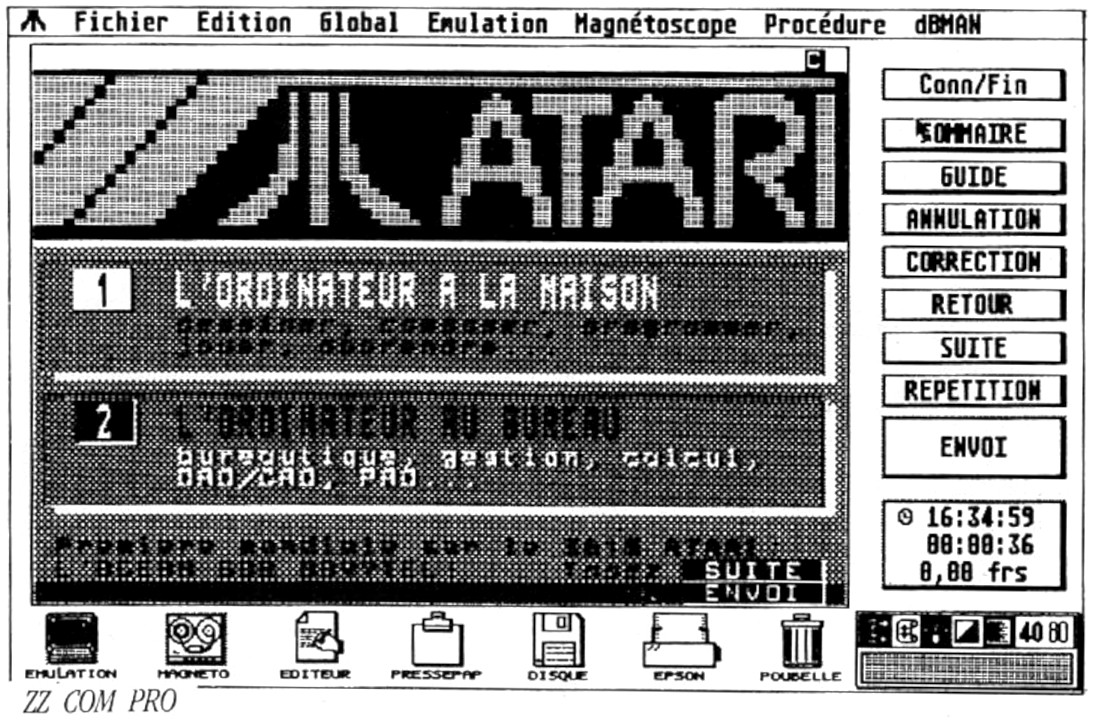
In the L'ordinateur à la maison section, there was a "Game Consoles" section dedicated to users of the Atari 2600 or Atari 130XE... featuring game catalogues, a dedicated thread in the discussion forum, information on Atari retailers, Atari clubs, and so on.
I think this article is important for its historical significance, especially for readers who have never heard of the Minitel. Did I myself use the "3615 ATARI"? The answer is no: after my Atari 800XL, I had an Atari 520STFM, then an Amiga 500, and then a PC when I started university in 1989. So, at the time, I was much more focused on university than on video games.
PS: To my great surprise, in the same issue of the magazine featuring the "3615 ATARI" advert, there are adverts for shops selling the entire Atari ST range… as well as the Atari 800XL for a mere 250 FRF (the price of a ST game!).
Who launched the Minitel?
It was the organisation responsible for the postal service and telecommunications in France, which was then a state monopoly. The company changed its name several times.
PPT (1878—1988, launched the Minitel) ⇒ France Télécom (1988—2013, when 3615 ATARI was launched) ⇒ Orange (2013—, current name).
"PPT" (Poste, Télégraphe et Téléphone) was a French government department responsible for... letters and parcels, telegraphs and telephones. It was the PPT that initiated the Minitel project, with an official launch in 1982-1983. The Directorate-General for Telecommunications of the former PPT became "France Télécom" in 1988, in response to a European directive and to reorganise the French telecommunications sector. "France Télécom" adopted the name of its subsidiary “Orange” in July 2013.
For the sake of clarity, I will refer only to France Télécom in the rest of this article.
So what exactly was the Minitel?
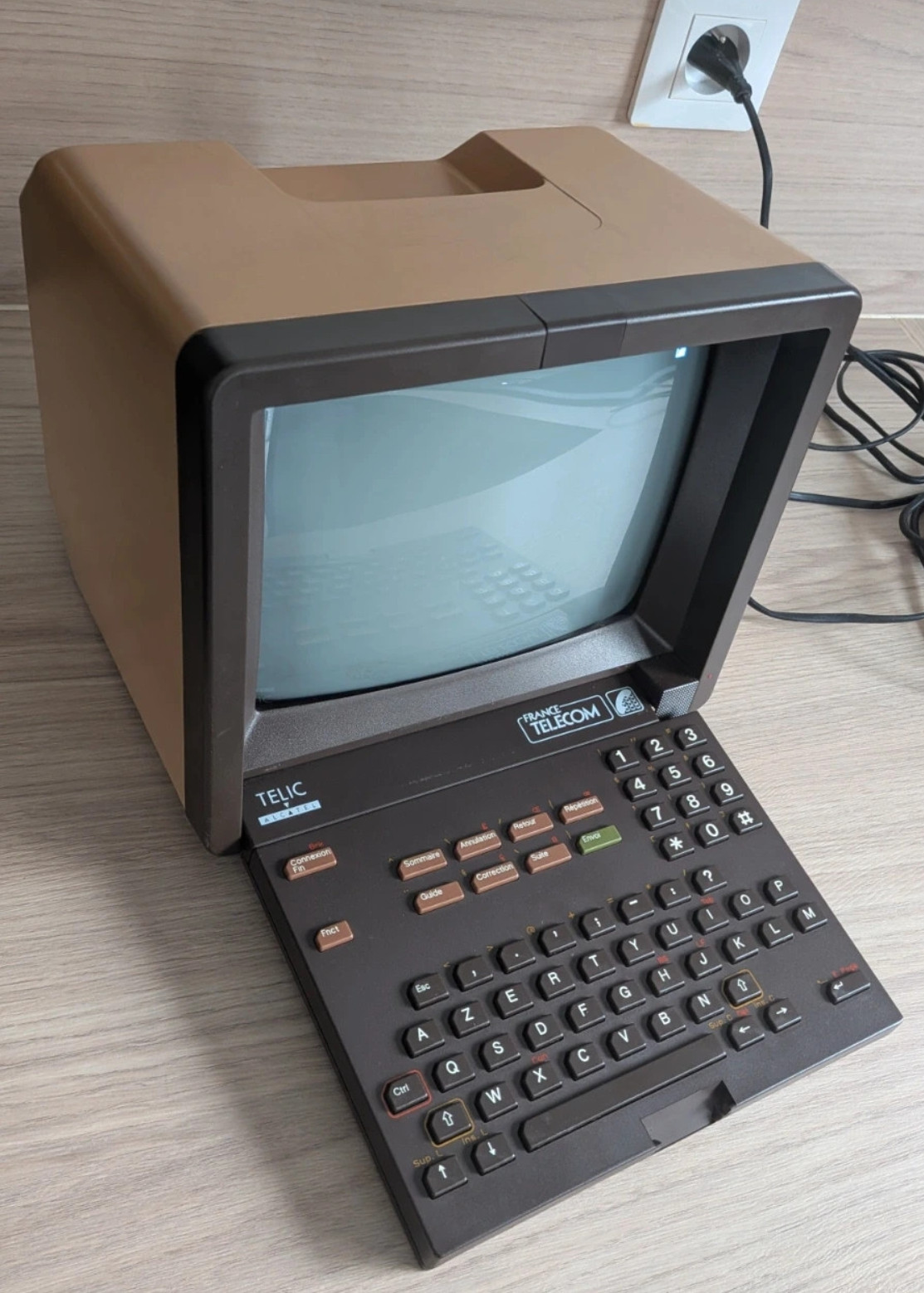
The Minitel was not a computer; the Minitel was simply a videotex terminal — essentially a dumb terminal with a built-in modem, a small screen, and a keyboard — that connected over the French public switched telephone network (PSTN) to centralized servers operated by France Télécom and third-party providers. It ran on the CEPT videotex standard (similar in concept to the UK's Prestel, but far more commercially successful).
Physically, the original Minitel 1 had a 9-inch monochrome screen displaying 40 columns × 25 rows of alphanumeric text, with a rudimentary graphics mode using DRCS (Dynamically Redefinable Character Sets) — basically loading custom glyphs into the character ROM to approximate bitmap images. Think of it as a character-cell display doing its best impression of graphics, not unlike how many home computers of the era handled things, but without any local processing power.
In fact, the video signal was in colour, but the terminals distributed free of charge to France Télécom subscribers had a black and white display. With an Atari ST, a simple cable and some free software (see below), it was possible to display the Minitel in colour on the Atari ST. Which is exactly what I did with my Atari 520STFM back then (around 1986-87-88).
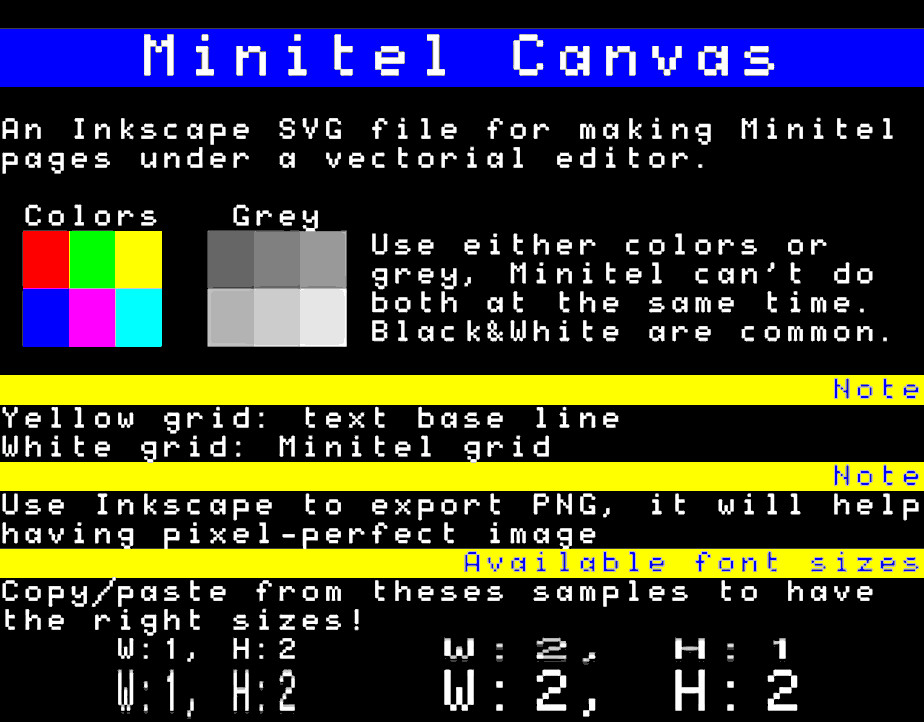
Unlike many American or British computers imported into France in the early 1980s, which came with their original QWERTY keyboards, the Minitel had an AZERTY layout (the French standard) keyboard with chiclet or hard plastic keys, along with dedicated navigation keys like Connexion (Connect), Fin (End), Retour (Return), and Envoi (Send).
The connection was asymmetric: 1,200 baud downstream / 75 baud upstream in early models (the 75-baud upstream was enough for keystrokes and short text input). Subsequently, the Minitel 1B ("Bistandard") introduced a "reversible" mode, allowing the user to switch from 1,200 baud down/ 75 baud up to 75 baud down/ 1,200 baud up and vice-versa. Later models reached 9,600 baud (V.23 and eventually V.32). The terminal had no CPU doing computation — it was purely a presentation device. All intelligence lived on the server side.
What was the Minitel originally designed for?
The Minitel was originally conceived as a replacement for the printed telephone directory.
In the late 1970s, the French PTT was facing rising costs for printing and distributing the annual annuaire (phone book). The paper directory was expensive to produce and was obsolete almost as soon as it was printed, given the churn in phone numbers.
The idea: instead of giving every subscriber a paper phone book every year, give them an electronic terminal connected to the phone network that could look up numbers in real time. The electronic directory was called l'annuaire électronique, and it was the killer app.
A pilot deployment was run in the département of Ille-et-Vilaine (Brittany) starting around 1980, and after success there, the national rollout began around 1982-1983. The terminal was distributed for free to telephone subscribers — and that free-hardware decision is absolutely central to everything that followed.
Why was the Minitel so successful?
Several factors converged:
- Free hardware. This is the big one. France Télécom gave away millions of terminals — the Minitel cost the manufacturer roughly 500-800 French francs to produce, but the consumer paid nothing. Getting the hardware installed in homes at zero upfront cost created massive adoption. The justification was that France Télécom was saving money on printing directories.
- A monopoly with deep pockets. France Télécom was the sole telecom operator in France. It could absorb the upfront cost of deploying millions of terminals as an infrastructure investment, knowing there was no competitor to undercut them. No startup could have done this.
- The "kiosk" revenue model — brilliant and ahead of its time. France Télécom operated the equivalent of a payment gateway and app store combined. To access a commercial service, the user dialed a special short number. The cost appeared directly on the user's phone bill — no credit card, no subscription, no friction. France Télécom then split the revenue with the service provider (typically a 60/40 split or similar, with variations).
This meant: - Users didn't need to trust a random vendor with payment — the bill came from the phone company, which everyone already paid.
- Users didn't need a credit/debit card… which meant that children and teenagers could use it too — All they had to do was "simply" ask the person who paid the phone bill for permission — That's the theory, anyway. When the phone bill arrived two, three or four weeks later, how could you tell who had actually used the Minitel on Wednesday the 3rd at 6 pm?
- Service providers didn't need billing infrastructure — they just connected their server to the Minitel network and got a cut of the metered revenue.
- The barrier to creating a service was extremely low: you needed a server, a V.23 modem, and a Minitel-compatible videotex front-end.
- Genuinely useful services. Beyond the directory lookup, the service ecosystem grew to include train schedules and booking (SNCF, including the famous "3615 SNCF"), weather forecasts, banking, stock quotes, classified ads, mail-order shopping ("3615 LAREDOUTE") {1}, news feeds, and — critically for revenue — the infamous messageries roses (adult/pink chat services) which accounted for a disproportionate share of total traffic and revenue. 3615 ULLA was one of the most iconic services.
- Early timing. In the mid-1980s, there was simply nothing comparable. Personal computers existed, but modems were slow, expensive, and required technical know-how. Online services like CompuServe existed but were aimed at the same technically literate minority. Minitel brought "online" to every household, including those who would never own a computer.
{1} At the time, "La Redoute" was the largest mail-order retailer in the whole of Europe — and, incidentally, also IBM's biggest customer in Europe. On the eve of the 21st century, the catalogue contained virtually anything and everything: 1,218 pages and 66,000 items in 1999. La Redoute was France's equivalent of Sears during its catalog heyday. Almost every household had the catalog at home, and people ordered everything from clothes to furniture through the mail.
How much did it cost to use the Minitel?
The communication terminal itself, the Minitel, was provided free of charge by France Télécom (for a standard, conventional Minitel).
The cost of the connection depended on the telephone number used.
"3615" was the standard telephone number used by the vast majority of services charged at the standard rate. In 1989, the price was just under 1 FRF per minute.
In 2026, the equivalent would be 0,28 EUR, 0.32 $ USD or 0.32 £ GBP, per minute of course. Back then, that was still the price of a butter croissant from la boulangerie, every 3 or 4 minutes. Or the price of the "Hard Drivin'" game for Atari ST or Amiga after 3 hours of connection.
As for billing, it couldn't be simpler! It was easy — and almost diabolical! The cost of Minitel usage was automatically added to the family's regular monthly phone bill. Like today, when the hotel's "room service midnight supper" is added to the bill, which you only find out when you're checking out. So, a 10-year-old could use the Minitel for hours on end on a lonely Wednesday afternoon... and the parents only realised when the monthly phone bill arrived in the letterbox.
Atari ST and the Minitel
When you connected an Atari 520ST (or any microcomputer) to the Minitel network, you had three fundamentally different use cases:
- Atari ST as deluxe Minitel terminal
- Atari ST to Atari ST communications
- Atari ST as Host/Server
The hardware requirements are very simple: an RS232C cable (Atari ST end) to a 5-pin DIN connector (Minitel end, "computer peripherals" socket). It is easy either to buy one ready-made or to make one yourself.
The software requirements are also very simple: Transity (Européenne de Télématique, download only), Emulcom 3.0 (Atari, Minitel emulator) or ZZ COM (Human Technologies, Minitel emulator). Other software, freeware and shareware were also readily available.
Use Case 1: Atari ST as deluxe Minitel terminal (Minitel in Standard Mode)
Your Atari ST becomes a fancy Minitel display. It receives screen data at 1,200 baud from remote servers and sends user input at 75 baud back. This works fine — the Atari's serial port can easily handle this.
What's more, this offers huge advantages:
- A colour display on a larger screen
- The computer's full keyboard, including the numeric keypad
- The ability to print (if you have a printer connected to the computer, obviously)
- The ability to record the entire session. This is very handy for accessing a pay-per-use Minitel site: you don't need to read anything, just scroll through the page and hang up as quickly as possible to pay the lowest possible charge. Once you've hung up, you can simply replay the session at your leisure on your computer.
- The ability to download files, a feature offered by 3615 ATARI, for example.
Use Case 2: Atari ST to Atari ST communications (Minitel in Reversed Mode)
Your Atari ST uses the modem provided by the Minitel to exchange files with another Atari ST computer.
Before the internet, if you wanted to chat or transfer data directly to another Atari ST user over the phone lines, you couldn't both be the "client".
If both Minitels were stuck in the default 75-baud transmit mode, they couldn't talk to each other properly. To establish a handshake and a stable connection between two computers, one Minitel had to act as the "Host" (transmitting at 1,200, receiving at 75) and the other as the "Terminal" (transmitting at 75, receiving at 1,200).
Being able to issue the modem reversal command via the ST's serial port (or manually typing Fnct + M then R on the Minitel keyboard) allowed two ST users to successfully link up.
Use Case 3: Atari ST as Host/Server (Minitel in Reversed Mode)
Your Atari ST hosts a Minitel service. It now needs to send substantial data to callers — menus, database queries, graphics, chat messages. At only 75 baud upload, this would be glacial. A 40-character line would take over half a second to transmit. A full page? Several seconds. That's unusable.
The solution: flip the modem so the computer can transmit at 1,200 baud while receiving acknowledgments at 75 baud.
In practice:
- Atari hosts the service logic (written in C or even assembler for speed)
- Multiple callers could dial into your number, with the Atari managing sessions
- You'd need multi-tasking software or careful interrupt-driven I/O
The Atari's 8 MHz Motorola 68000 was overkill for simple Minitel emulation, but perfectly matched for hosting modest services that a real Minitel terminal couldn't run locally.
Why did the Minitel fade away?
- The Internet outclassed it technically. The Minitel's 40-column text display, 1,200-baud connection, and server-side-only architecture couldn't compete with graphical web browsers on PCs with 28.8k or 56k modems. Even in its upgraded forms (Minitel 2 with colour, faster speeds), the fundamental design was locked into a pre-web paradigm.
- Open vs. closed. The Minitel was a walled garden controlled by France Télécom. While this was a strength early on (quality control, unified billing, no spam), it became a liability. Anyone could put up a web page; launching a Minitel service required interfacing with France Télécom's network infrastructure and conforming to their videotex protocol stack. The innovation rate was throttled.
- The business model inverted. France Télécom's revenue-sharing kiosk was a marvel in 1985, but by 1998-2000, the internet offered free information. Services migrated to the web. Why pay per-minute Minitel rates when a free website gave you more, faster, and in colour?
- Hardware lock-in. The terminal was a purpose-built appliance. As PCs became affordable in French households (helped by government programs in the late 1990s), owning a separate, single-purpose terminal made less and less sense. The PC could do everything the Minitel did — and vastly more.
- France Télécom's own transition. As France Télécom itself began investing in internet infrastructure (Wanadoo was their ISP brand), the Minitel became an internal competitor for the same customers' time and money. There was institutional inertia, but eventually the economics pointed one way.
The service was officially shut down on June 30, 2012, having lingered for years with a shrinking user base — mostly older users checking phone numbers, some die-hard messagerie users, and a handful of niche professional services.
Avant garde
The Minitel was, in a very real sense, a cloud-computing thin-client terminal deployed at national scale a decade before the term existed.
It foreshadowed:
- App stores (service providers connected to a platform with unified billing)
- SaaS/revenue sharing (France Télécom as platform, service providers as developers)
- Thin clients (the terminal did nothing locally; all computation server-side)
- Metered cloud access (per-minute billing on a shared infrastructure)
It accomplished all of this using hardware that Atari 8-bit (& 520STFM) computer owners of the time would have been familiar with. The Minitel's V.23 modem running at 1,200/75 baud, its character-cell display with downloadable glyphs, and its phone-line dial-up connection were all part of the same technological world your audience inhabited. The difference was that in France, this infrastructure reached into practically every home — not through market forces, but through a government monopoly that treated connectivity as a public utility.
Whether that model is ultimately superior to the open, chaotic internet that replaced it is a debate worth having. The Minitel offered security, simplicity, and universal access at the cost of openness, speed, and innovation. The internet gave us everything — but it also gave us spam, malware, and a fragmentation that the Minitel's walled garden never suffered. It's a trade-off that resonates with anyone who remembers computing in the 1980s: do you want a polished, curated experience, or an open frontier?
Knowledge base article: kb-culture-0005-3615-atari.
REV. 001.