Foreword
Talking with some very young colleagues at the office made me fully realise just how difficult it is to describe what the world of video games and personal computers was like in the early 1980s.
Their impression of it is distorted by series such as "Stranger Things" and other recent films set in the 80s. It simply doesn't match what I experienced as a child born in 1971, a teenager in France during the 80s.
How can I explain to them that, at the time, all of this was so new, so exciting? Of course, everyone — parents included — quickly understood what video game consoles were for. But trying to explain that you wanted a computer — that we called a "microcomputer" — which was far more expensive than a video game console, was quite another matter. Why? What for?
First of all, to play video games — that was the obvious honest answer, and there was no point denying it, even for those who swore otherwise. But you could do so much more with it, especially learning to program the machine, which seemed incredibly promising for the future. The name "Atari" was practically synonymous with "video game" back then. So, if you wanted to ask for an Atari computer, you needed solid arguments to justify it. And why an Atari rather than something else? There were so many options!
We didn't have access to many sources of information back then. Apart from a few magazines, there wasn't much at all. Spending time in a computer or video game shop was genuinely entertaining, even if you didn't buy anything. And an hour or so in an arcade was like stepping into a whole new world — with no direct view of the outside, constantly stimulated by those flashy colours and sounds coming from all around. The games were absolutely stunning — especially visually. They were far superior to their microcomputer versions, which were released only months, or even years, later.
Today's generation can feel anxious when they're disconnected, without a network, cut off from their tribe. But that was completely normal in the 80s. The Internet did exist, but it wasn't available to the general public — only to the military and universities. In fact, ordinary people had never even heard of the Internet, and websites hadn't been invented yet. We were only just beginning to imagine connecting via a modem — painfully slow — to a local BBS (Bulletin Board System). In the US, other services like CompuServe, PLATO, The Source and so on were available, but not in France. That said, at the same time, we did have the Minitel.
To try to begin sketching out as accurately as possible the contours of these technological revolutions of the 1970s and 1980s, I've selected a collection of Wikipedia articles, grouped by theme. Of course, this isn't exhaustive. Of course, this selection reflects a certain perspective on certain topics, and some choices had to be made. But the approach is entirely honest. You won't be fascinated by every single article, but I'm certain that, like me, you'll make some wonderful discoveries. I plan to compile these articles into about twenty themed books. Happy reading, happy exploring.
Volume A "Video Games & Consoles"
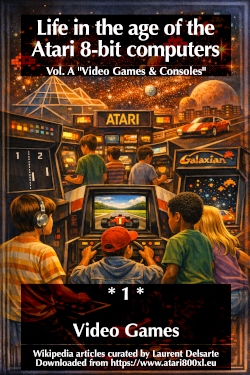
Life in the age of the Atari 8-bit computers
Volume A "Video Games & Consoles"
Book 1 "Video Games" (LIFE-ATARI-Vol-A-Book-01-Video-Games)
Document type: downloadable .PDF book
Format: A4
Number of pages: 417
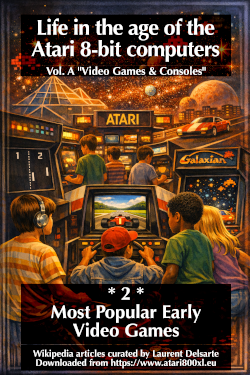
Life in the age of the Atari 8-bit computers
Volume A "Video Games & Consoles"
Book 2 "Most Popular Early Video Games" (LIFE-ATARI-Vol-A-Book-02-Most-Popular-Early-Video-Games)
Document type: downloadable .PDF book
Format: A4
Number of pages: 579
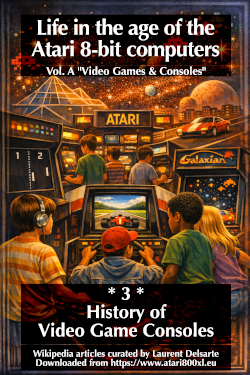
Life in the age of the Atari 8-bit computers
Volume A "Video Games & Consoles"
Book 3 "History of Video Game Consoles" (LIFE-ATARI-Vol-A-Book-03-History-of-Video-Game-Consoles)
Document type: downloadable .PDF book
Format: A4
Number of pages: 214
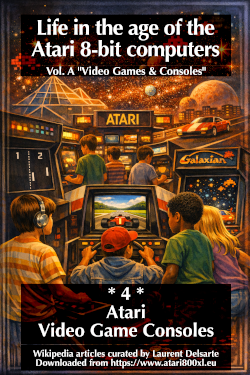
Life in the age of the Atari 8-bit computers
Volume A "Video Games & Consoles"
Book 4 "Atari Video Game Consoles" (LIFE-ATARI-Vol-A-Book-04-Atari-Video-Game-Consoles)
Document type: downloadable .PDF book
Format: A4
Number of pages: 250
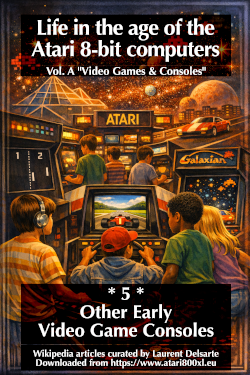
Life in the age of the Atari 8-bit computers
Volume A "Video Games & Consoles"
Book 5 "Other Early Video Game Consoles" (LIFE-ATARI-Vol-A-Book-05-Other-Early-Video-Game-Consoles)
Document type: downloadable .PDF book
Format: A4
Number of pages: 108
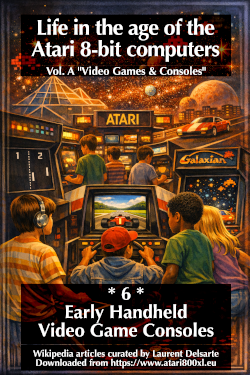
Life in the age of the Atari 8-bit computers
Volume A "Video Games & Consoles"
Book 6 "Early Handheld Video Game Consoles" (LIFE-ATARI-Vol-A-Book-06-Early-Handheld-Video-Game-Consoles)
Document type: downloadable .PDF book
Format: A4
Number of pages: 100
Volume B "Companies, People, 8-bit technologies & Languages"
(come back soon!)
Volume C "Atari Home Computers & others"
(come back soon!)
Knowledge base article: kb-culture-0003-life-in-the-age-of-the-atari-8-bit-computers.html
REV. 003.